 This is a guy I know here in Nepal. From London originally where he worked in graphic design and photography for branding and advertising. For over a year he has been in India and Nepal taking some great photographs. Something in his approach yields fantastic results. I think just patience, empathy and a passion for representing the people he pictures. Perhaps he would disagree. I recommend downloading the photo journals, 7 in all. I have a lot of catching up to do.
Friday, October 03, 2008
Alex Treadway
This is a guy I know here in Nepal. From London originally where he worked in graphic design and photography for branding and advertising. For over a year he has been in India and Nepal taking some great photographs. Something in his approach yields fantastic results. I think just patience, empathy and a passion for representing the people he pictures. Perhaps he would disagree. I recommend downloading the photo journals, 7 in all. I have a lot of catching up to do.

Saturday, September 13, 2008
Ours is not the common gold.
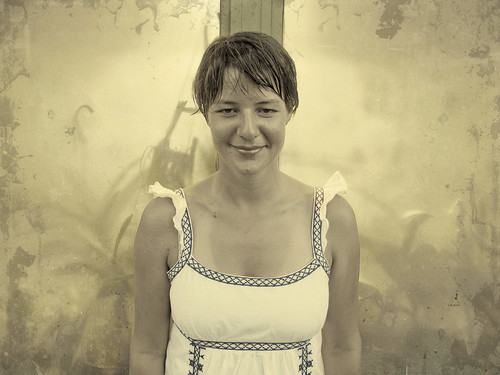 Ours is not the common gold., originally uploaded by AnomalousNYC.
AnomalousNYC, a very special guy it seems. Activist for Palestine, critic of the state of the USA, street-portraiture craftsman, gentle Photoshopper. Check out his photostream - just click on the picture.
Wednesday, August 20, 2008
Team VIM: Sucata run report
"Gathered around the town square were 50 cars with UK number plates, all brightly painted to distract from their lack of road worthiness. With a 'tally ho' and some throaty revving of engines, we all chugged of in the direction of La Rochelle, waving and smiling to the happy, flower-throwing population of Rouen.
"We continued along the road in formation, keeping an eye on each other in string-secured rear-view mirrors. When someone needed a pee-break, we'd all sense it and pull over at the next service station, leaving again in the same order we arrived.
"When somebody broke down, we'd all pull together to fix the problem, and failing that, the biggest car would graciously volunteer to tow the retiree to the end of the stage"
etc etc...
And perhaps for some this was the reality. But not quite for team VIM.
I met up with my co-pilots, and the beautiful, in-full-working-order Volvo estate in Mende, France, 707km from the start. So not quite the start and not quite a banger (although it refused to start many times). Would we go to the start and be a part of this historic moment? Actually, no. We did get to La Rochelle for the end of stage one. And we did plan to fully integrate. It was just that the Sucateers, as we were know, tended to be of the pastey, beer drinking, crap talking variety. Its an unfair, inaccurate generalisation, but one we immediately decided to go with. From this point on, it was team VIM alone.
A day in the life went something like this. First sleeping. No hotels or cosy B&Bs for us, rather Wild Camping. Wild in the sense of not on a camping site that is - it is pretty hard to be or appear wild arriving in a maroon Volvo estate. But around 6pm, after the usual one-hour shopping trip to the hypermarché, we'd begin driving, looking for a secluded place where we could pitch our 8 euro wendy tents (bought from the respected camping equipment supplier and newsagent WH Smith). Depending on the landscape, this could be easy or hard. On hilly terrain, hard, as most usable space is used by people. Most of the terrain we passed by was hilly. So this camping spot hunt could take up to 3 hours. Some spots were excellent and others were dirty compromises close to informal rubbish dumps.
Once established out of view, the barbecue would be lit and bags of fresh food unpacked along with remains from previous days which had sweated for a day in the hot sun on the back seat. As a tactic to prevent being moved on by locals or the police, we'd all drink several plastic beakers of wine so that driving was impossible. After creative barbecuing of red meat and fish, more wine and eventual bed. Getting out of sleeping bags would happen in the morning only when we could no longer bear the baking (mid-morning) sun. Then pack up and to the nearest cafe for coffee and discrete use of the sanitation facilities. Drive all day, find a supermarket and repeat.
This is how our rally looked until Portugal and it was good, clean (but unwashed) fun.
This first night was nearly the end of team VIM. Taking refugee from the tourist masses in a bar with local students we met a Liverpool loving girl who later, after many vodka-with-menthes, would invite us to crash at her place. Team VIM would accept this offer, the alternative being to sleep in a park (or not sleep). At a certain point, one of the team VIM members would be attacked by this girl and rendered incapable of employing the "All for one and one for all" motto of solidarity, which probably would have been a good idea. This betrayal would almost fracture the team when another team member fully employed his inalienable human right to have a hissy fit. After agreeing to a punishment of confinement to the back seat and 2 hours of silence and paying for the breakfast in the holiday inn, the rally could continue.
At the destination, Cabo de Roca, the most westerly point in Europe, there was a barbecue to greet the finishing participants. We were late and missed it having gone to the wrong location. Finally arriving, the car park above this rocky headland was devoid of cars except for one with steamed up windows and someone mouthing a short Portuguese phase at us. Time to read the instructions properly and get to the closing ceremony / party. And what a party!
The end of the rally was celebrated with a party in a kool nightclub. Here the prizes would be awarded to the owners of the cheapest car, best decorated, best fancy dress etc etc... VIM was in line to win nothing due to breaking the £250 car cost rule and not actually having started.
 To attend this party was to fully confront English Drinking Culture. After paying a hefty 30 Euro entrance fee, drinks were free until 11.30. Naturally this meant that almost every horizontal surface, not excluding the floor, was being used to stockpile booze. As 11.30 arrived, the bars became deserted as people returned to their rows of beers to charge up their personalities. It looked pretty seedy.
There then came the good news that nearly £90,000 had been raised for the gemini-i charity, The representative for the charity was sincerely thankful as for them, this is a huge cash sum with which they can advance may of their projects. Additionally, if we wanted to learn more about the charity, we could turn up to the office in London, and even chat to some kids in Kenya online - an offer that brought the daily star mentality out in the 2/3 pissed audience.
So from this bunch of geeky, pastey, binging, car obsessed crowd came, courtesy of their sponsors wallets, some good. Buggy, ever mistrustful of NGOs, has written to the charity asking for the accounts to see exactly where all the money goes.
Summary:
If you sponsored us, thank you very much indeed. Despite the nonsense, planting only 5 tulip bulbs against the promised forest of trees, the banality and lack of difficulty in taking part in this event and the delay in reporting, 1285 GBP did go to a good cause in the time when the pound was reasonably strong. Let’s hope the charity spent the money before the Pound’s slide.
Best wishes to you,
Team VIM
To attend this party was to fully confront English Drinking Culture. After paying a hefty 30 Euro entrance fee, drinks were free until 11.30. Naturally this meant that almost every horizontal surface, not excluding the floor, was being used to stockpile booze. As 11.30 arrived, the bars became deserted as people returned to their rows of beers to charge up their personalities. It looked pretty seedy.
There then came the good news that nearly £90,000 had been raised for the gemini-i charity, The representative for the charity was sincerely thankful as for them, this is a huge cash sum with which they can advance may of their projects. Additionally, if we wanted to learn more about the charity, we could turn up to the office in London, and even chat to some kids in Kenya online - an offer that brought the daily star mentality out in the 2/3 pissed audience.
So from this bunch of geeky, pastey, binging, car obsessed crowd came, courtesy of their sponsors wallets, some good. Buggy, ever mistrustful of NGOs, has written to the charity asking for the accounts to see exactly where all the money goes.
Summary:
If you sponsored us, thank you very much indeed. Despite the nonsense, planting only 5 tulip bulbs against the promised forest of trees, the banality and lack of difficulty in taking part in this event and the delay in reporting, 1285 GBP did go to a good cause in the time when the pound was reasonably strong. Let’s hope the charity spent the money before the Pound’s slide.
Best wishes to you,
Team VIM
 To attend this party was to fully confront English Drinking Culture. After paying a hefty 30 Euro entrance fee, drinks were free until 11.30. Naturally this meant that almost every horizontal surface, not excluding the floor, was being used to stockpile booze. As 11.30 arrived, the bars became deserted as people returned to their rows of beers to charge up their personalities. It looked pretty seedy.
There then came the good news that nearly £90,000 had been raised for the gemini-i charity, The representative for the charity was sincerely thankful as for them, this is a huge cash sum with which they can advance may of their projects. Additionally, if we wanted to learn more about the charity, we could turn up to the office in London, and even chat to some kids in Kenya online - an offer that brought the daily star mentality out in the 2/3 pissed audience.
So from this bunch of geeky, pastey, binging, car obsessed crowd came, courtesy of their sponsors wallets, some good. Buggy, ever mistrustful of NGOs, has written to the charity asking for the accounts to see exactly where all the money goes.
Summary:
If you sponsored us, thank you very much indeed. Despite the nonsense, planting only 5 tulip bulbs against the promised forest of trees, the banality and lack of difficulty in taking part in this event and the delay in reporting, 1285 GBP did go to a good cause in the time when the pound was reasonably strong. Let’s hope the charity spent the money before the Pound’s slide.
Best wishes to you,
Team VIM
To attend this party was to fully confront English Drinking Culture. After paying a hefty 30 Euro entrance fee, drinks were free until 11.30. Naturally this meant that almost every horizontal surface, not excluding the floor, was being used to stockpile booze. As 11.30 arrived, the bars became deserted as people returned to their rows of beers to charge up their personalities. It looked pretty seedy.
There then came the good news that nearly £90,000 had been raised for the gemini-i charity, The representative for the charity was sincerely thankful as for them, this is a huge cash sum with which they can advance may of their projects. Additionally, if we wanted to learn more about the charity, we could turn up to the office in London, and even chat to some kids in Kenya online - an offer that brought the daily star mentality out in the 2/3 pissed audience.
So from this bunch of geeky, pastey, binging, car obsessed crowd came, courtesy of their sponsors wallets, some good. Buggy, ever mistrustful of NGOs, has written to the charity asking for the accounts to see exactly where all the money goes.
Summary:
If you sponsored us, thank you very much indeed. Despite the nonsense, planting only 5 tulip bulbs against the promised forest of trees, the banality and lack of difficulty in taking part in this event and the delay in reporting, 1285 GBP did go to a good cause in the time when the pound was reasonably strong. Let’s hope the charity spent the money before the Pound’s slide.
Best wishes to you,
Team VIM
Friday, August 01, 2008
Business as usual
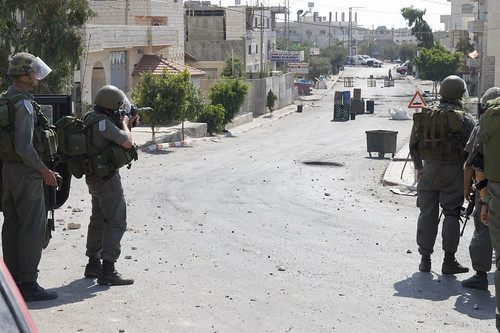 Business as usual, originally uploaded by rpb1001.
In this scene you are looking into the village of Ni'lin from its main entrance. The photo was taken around 4pm after the funeral of Ahmed Mousa, the 10 year old boy shot dead on 30th July 2008. There are about 20 soldiers stationed here in 3 jeeps. To the left and behind the photo is the bakers house with the family locked inside and 3 soldiers on the roof. Outside the village is a road which leads to nearby settlements. About 200m down it is a checkpoint which I believe will become part of the separation barrier as it is constructed here. And this is what it is all about of course. In the distance are 'shabab' or youths - about 10 to 15 - throwing stones at these soldiers and shouting comments, probably not very nice ones. The road blocks are intended to stop the army coming into the village. The area stinks from the tear gas that has landed on it over the last 24 hours. The distance is just enough for a stone to reach after bouncing several times on the floor. So not a great danger. One stone, the size of half a fist bounced in a knocked the toe of a solder standing to the left and he looked upset by that. There is a lot of standing around going on. From time to time a stone will come and something will be shouted at the soldiers. They might reply with a tear gas round fired directly (rather than arcing one through the sky) or a rubber bullet. I saw at least two hits to the legs in this time. That is some pretty good shooting. Behind the jeep to the left is a soldier leaning against the wall busy shooting the occasional rubber bullet - and just to mention it these are steel or brass cylinders coated in a thin layer of rubber, not soft and bouncey as you might imagine, similar in weight to a car wheel nut. See: www.flickr.com/photos/kamshabam/503309519/ and www.flickr.com/photos/16883316@N03/2289392766/ A friend John, a photographer got a great image of this 'sniper' for want of a better word shooting while his colleague leans his head against the door of the jeep with his arms hanging down by his side in exasperation or tiredness. According to local and international eyewitnesses, around 7.30pm, after more of the same for 3 or so hours, one of these jeeps drove up towards the road blocks and fired rubber bullets from the jeep at a range of around 10m at a boy (18) and damaged his skull. He lies brain dead in hospital now. See: www.guardian.co.uk/world/israelandthepalestinians
Thursday, July 03, 2008
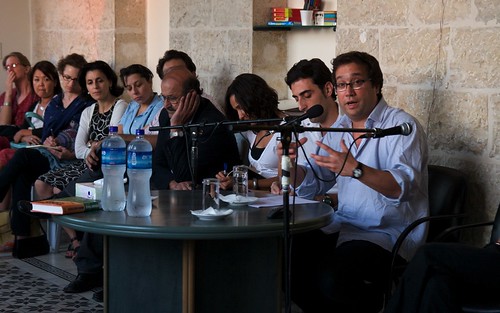
Eyal weizman book reading:- Hollow Land: Israel's architecture of occupation
Went this evening to a fascinating lecture by Eyal Weizman who is author of Hollow Land. He discussed the architecture of occupation. Two part of the lecture stuck out. Firstly the discussion of inverting the use of space. An alley - in it's normal function it should allow people and vehicles to pass. The refugee camp in question, Balata in Nablus, was designed of course with alleys for this purpose. The Israeli approach, to avoid conventional ambushes of alleys, was to view alleys as spaces not to be used for access. The result being hundreds of holes in people's walls, walking through walls, like walking on water, making the inside the outside.  In this way the IDF carried out missions having surprise and unpredictability on their side. But leaving a large mess and trauma behind each time. The second anecdote discussed the architecture of settlements and that the location could be influenced by things other than politics. He discussed a bend in the road a few kilometres east of Ramallah. While driving around this bend in the road, settlers noticed a lack of reception on their mobile phones. Citing this as a security issue (as a terrorist attack could happen within this 20 seconds and help could not then be summoned) they persuaded Orange to build an antennae there (which in turn required that the military annex the land for security purposes).
  So the antennae required an access road form the main road. It required power and a water supply for building. On completion it required a 24 hour guard who lived there with his family. Through a series of aerial photographs, Weizman shows how the guard's friends came to join him on the hill top and now around 150 people are living there. http://www.amazon.com/Hollow-Land-Israels-Architecture-Occupation/dp/1844671259?tag=particculturf-20
In this way the IDF carried out missions having surprise and unpredictability on their side. But leaving a large mess and trauma behind each time. The second anecdote discussed the architecture of settlements and that the location could be influenced by things other than politics. He discussed a bend in the road a few kilometres east of Ramallah. While driving around this bend in the road, settlers noticed a lack of reception on their mobile phones. Citing this as a security issue (as a terrorist attack could happen within this 20 seconds and help could not then be summoned) they persuaded Orange to build an antennae there (which in turn required that the military annex the land for security purposes). So the antennae required an access road form the main road. It required power and a water supply for building. On completion it required a 24 hour guard who lived there with his family. Through a series of aerial photographs, Weizman shows how the guard's friends came to join him on the hill top and now around 150 people are living there. http://www.amazon.com/Hollow-Land-Israels-Architecture-Occupation/dp/1844671259?tag=particculturf-20
Subscribe to:
Posts (Atom)
