Well this is a bit weird, but we're just practising for taking pictures at Everest basecamp - subject to anybody wanting to have their picture taken that is. There we need to somehow capture the physical change that spending time on the mountain brings. It is a before and after shot - but we'd like to bring them together in one frame. Will be a challenge!
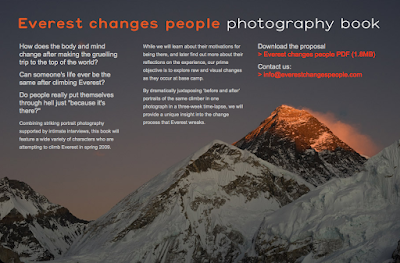
Here is a plan for a photography book that friends Alex and Billi are going to do. Billi is climbing Everest this season and Alex, mentioned before on this blog, will be up there taking pictures.
I have never been involved in the making of a book before. It is pretty tricky. Do we want to do it to make the book, or make money. How to find some money to make the project happen, to cover the 2 or so months to get the material and edit it into a draft? Who really buys these kinds of books? How many get printed? Are coffee table books all loss leaders?
We've sent the proposal out to quite a lot of people now. We've had a lot of feedback: From the point of view of the (pre-)proposal, it is not snappy and salesy enough. Perhaps there is not enough writing proposed (600 words, perhaps 1500 is nearer the mark)? And from someone involved in expedition leading, that the residents at base camp are already rather treated like lab-rats: medical research, physiological research, pictures, books and so on.
Anyhow, see what you think. Click the picture above and download the 3 page proposal. See what you think. Would you buy a copy? What would you call it?
Oh - and faces of Everest is kind of there already, and is interesting: http://facesofeverest.blogspot.com/
"When you take that many long-suffering, war-torn groups and put them in the same place, how can you not have peace?" asked former president Jimmy Carter, who will lead talks among the various Ethniklashistani groups. "This hatred cannot possibly last long."
I am planning a trip to Janakpur with Erin. It currently postponed due to the violence and shutdown of the Terai region. She was trying to explain what was happening - I have not been keeping up. What she told me reminded me of a piece in the Onion (America's finest news source) that I read in print over 8 years ago. It seemed apt. It is a piece of genius writing.
Read it here: http://www.theonion.com/content/node/28369?utm_source=EMTF_Onion and do forward it to any of your friends working in the peace industry!
More craziness in Ni'lin. I spent quite a bit of time there last summer. The story is quite simple. Nil'in is a small village who land has been annexed previously for a nearby settlement and now more land is being lost for a section of the 'security barrier' (The Wall). The route of the wall / security barrier is in the hands of the army and has little to do with green lines or previously agreed borders, only security. In this case, the fence / road / ditch etc will leave a large buffer between it and the settlement. Good bye olive trees.
Anyhow, the villagers are rightly protesting this. I can't remember all the details of court cases and subsequent appeals but whatever happened the construction goes on relentlessly. An average protest aims to walk from the village square to the current point of construction activity and peacefully stop the work there. Rarely does it get that far. Sometimes its gets close to the construction but then the tear gas flies and everybody runs. Sometimes the protest is stopped in the village itself. Sometimes a 'shit gun' is used on the crowd. Basically something that smells like very raw sewerage is sprayed on to people. It makes you want to wretch to smell it and it is ver hard to get rid of. Later in the protest rubber bullets, or rubber coated steel bullets to be precise, are used. If you're very unlucky, live ammunition will be used. I have been in this situation and it is terrifying. While I was there, two were killed. One a 10 year old boy (Ahmed Mousa) was shot in the head by a military policeman (or was it border police) from quite a distance (maybe 100m from route of the barrier) while playing with friends in the early evening. Another was killed by a rubber (coated steel) bullet shot to the head.
Anyway, enough. It is a shocking way to deal with legitimate protest.
As Groucho Marx said: Military justice is to justice what military music is to music.
To get a feel for how it is, you can see a trailer from a documentary that never was: "Closed Military Zone" by Eran Vered and Rick Berman.
Back to the recent issue. See the release below:
13th Friday 2009, Ni’lin Village: An American citizen has been critically injured in the village of Ni’lin after Israeli forces shot him in the head with a tear-gas canister.
Tristan Anderson from California USA, 37 years old, has been taken to Israeli hospital Tel Hashomer, near Tel Aviv. Anderson is unconscious and has been bleeding heavily from the nose and mouth. He sustained a large hole in his forehead where he was struck by the canister. He is currently being operated on.
Tristan was shot by the new tear-gas canisters that can be shot up to 500m. I ran over as I saw someone had been shot, while the Israeli forces continued to fire tear-gas at us. When an ambulance came, the Israeli soldiers refused to allow the ambulance through the checkpoint just outside the village. After 5 minutes of arguing with the soldiers, the ambulance passed.
– Teah Lunqvist (Sweden) - International Solidarity Movement
The Israeli army began using to use a high velocity tear gas canister in December 2008. The black canister, labeled in Hebrew as “40mm bullet special/long range,” can shoot over 400 meters. The gas canister does not make a noise when fired or emit a smoke tail. A combination of the canister’s high velocity and silence is extremely dangerous and has caused numerous injuries, including a Palestinian male whose leg was broken in January 2009.
This, according to ICIMOD, is a wiggly line which might form a possible route of the GHT - the Great Himalayan Trail. Basically it is a long distance trail with out a route. You need a pile of good maps and a local guide and then you can choose yourself where you walk!
Previously it (one route) has been walked in 68 days by Rosie Swales. Will be interesting to hear of other people walking the length of Nepal.
Disclaimer: No part of this website or any part of the content, copy and images may be reproduced or re-distributed in any format without the prior approval of its owner. thehalfhog.com is very happy to permit widespread use of its intellectual property but permission must be gained in advance. To get permission, please


 Well this is a bit weird, but we're just practising for taking pictures at Everest basecamp - subject to anybody wanting to have their picture taken that is. There we need to somehow capture the physical change that spending time on the mountain brings. It is a before and after shot - but we'd like to bring them together in one frame. Will be a challenge!